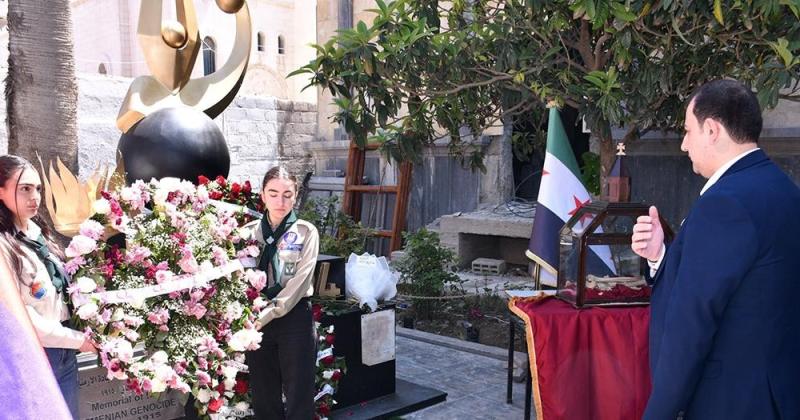
Every year, on April 24, the world remembers the martyrs of the Armenian Genocide of 1915. Like many cities shaped by memory, the Syrian city of Qamishli stands, on the eve of this anniversary, to the rhythm of a remembrance that never grows silent.
At the memorial for the martyrs of the Armenian Genocide, located at St. Hagop Armenian Orthodox Church, people arrive from different directions carrying flowers and candles, leaving silence to complete the rest of the story.
For me, this commemoration was never an ordinary day. It was a collection of stories I had heard since childhood, reaching me through the voices of my ancestors, filled with images of a long journey of exile that began in Mardin and later ended in the Syrian desert of Deir ez-Zor.
Mardin, the birthplace of my ancestors, was the city where homes were abandoned in haste and songs were suddenly interrupted. As it was told to me, it had once been a place where people shared both joys and sorrows, before that image abruptly turned into marches toward the unknown.
There, stories of martyrdom and displacement were written. And from there, life would later begin again.
As a child, I would eagerly wait for the words of my father, Hagop, whenever he sat among others to recount how his family survived that fate. In those moments, his voice became a window into another world. I listened to him as though the story were being told for the first time, even though it was repeated every year on this anniversary, and on many other days as well.
Those moments formed the earliest features of my relationship with memory: not as an event merely narrated, but as a life relived each time, while I tried to understand it.
Since childhood, I have carried this memory from my family as though it were part of my own personal formation. I grew up listening to the stories of my ancestors who were displaced from the city of Mardin. And with each passing day, the longing in my heart grew stronger for a city that lived within me, though I had never visited it.
Mardin was one of my dreams. I used to imagine the scenes of those caravans: tired faces, heavy footsteps, and land being left behind for the last time, toward an unknown destiny. These stories were not merely family tales to me; they were living scenes in my imagination, silently repeating within me.
With every account, a question formed inside me, one for which I could not find a clear answer: How can a person lose everything and still go on living?
My ancestors were among the few families who escaped death. Their survival came thanks to a family from the Jajan tribe, with whom my grandfather’s family had maintained a good relationship and business partnership. The greatest credit goes to a kind woman whose name I never knew. Her brother had been my family’s business partner, but he had died without children.
At that time, the caravans were being driven from Mardin toward Ras al-Ayn, on an exhausting journey of more than 200 kilometers that lasted nearly seven days amid hunger, thirst, and fear.
When the caravans arrived in Ras al-Ayn, tents were set up for the exhausted families, while soldiers moved daily among the people, searching for gold and possessions and stripping them of whatever remained in their hands. Families lived under conditions so harsh that they were forced to give up their last belongings in exchange for a piece of bread or a sip of water.
My grandfather’s family had managed to hide a gold belt, estimated at around 300 gold liras. When one of the soldiers arrived, he asked my great-grandfather, Daoud Khabbaz, what they had. My great-grandfather replied: “This is a gold belt.”
The soldier immediately realized that they were goldsmiths and said to him: “You are a goldsmith. How much do you want for this belt?”
My great-grandfather answered that the belt was worth 300 gold liras, but that he was willing to give it to him for the equivalent of 150 gold liras.
The soldier replied: “What belongs to you is not yours. It is mine.”
Then he snatched the belt from my great-grandfather.
At that moment, my great-grandfather lowered his head, and his eyes filled with tears. Surprised, the soldier asked him: “Why are you crying, old man?”
He answered in a voice heavy with grief: “I cry because if Aslan bek (Bek—a title of honor in the Ottoman tradition, similar to "Lord" or "Sir" but carrying greater nobility and authority) were alive, we would never have reached this state. We were brothers and business partners from the days of Viranşehir and Sasun, and later in Mardin. I was his partner and supported him financially. But he died without leaving descendants…”
In an unexpected moment, the soldier suddenly froze when he heard the name Aslan Bek. He immediately threw the belt back at my great-grandfather and hurried to his mother, who belonged to the same family as Aslan Bek.
He told her what had happened and recounted the story of the old man who said he had been the partner of her late brother.
She then told her son firmly: “My son, this man is your uncle. If you do not bring all of them back to our house, my milk will be forbidden to you.”
The soldier immediately returned to the camp with a number of armed men and ordered my grandfather’s family to prepare to leave. The family thought that the moment of death had arrived and that they were being led to an unknown fate, as had happened to many before them.
Tears filled the eyes of my great-grandfather’s wife and his aunt. They gathered their belongings and walked behind the soldiers toward what they believed was their end.
But the road ended at the home of Aslan Bek’s sister, and there, the path to a new life began.
As soon as the woman saw my family, she came out to the door ululating, welcoming them as though they had returned from certain death to a new life. She then said the words that remained in the family’s memory, generation after generation:
“Aslan died without leaving descendants, but his sister did. This is your home, and you will remain here. Even if all the Ottomans come, they will not be able to take you from this place. I am your sister, and my children are your children. Aslan is not dead. Aslan is alive.”
And so, by a miracle, my ancestors’ family escaped what seemed to be certain death. That woman embraced them in her home in Ras al-Ayn until conditions calmed.
After a long path of movement and displacement, my family settled in the Syrian city of Qamishli. There, they began again from nothing, working, building, and returning to the family profession of crafting silver and gold. They wrote the survival story of an Armenian family from Mardin, carrying with them the legacy of longing and the memories of their first homeland.
On one occasion, my family decided to visit Mardin. For me, the journey was not ordinary. It was an attempt to search for a tangible trace of everything I had heard, and to fulfill one of my most beautiful dreams.
There, among the stones of the old city of Mardin and its pure air, I tried to find the address of my grandfather’s family home. And indeed, I found it. But we were unable to reach the house itself because of excuses given by local residents. The distance between me and that place felt greater than a matter of footsteps.
I returned to Qamishli carrying a heavy feeling, as though memory is closest when it remains far away. Yet the dream of a second visit was renewed within me, as though dreams, once fulfilled, do not end, but take shape again.
In Qamishli, life continued, but memory remained present. Over the years, it was no longer limited to pain alone. On April 24 of last year, the scene felt different to me. Armenians were not the only ones commemorating the anniversary; Arabs, Kurds, Yazidis, and nearly all components of the city were present as well.
They stood together, placed flowers, and walked in a single candlelight procession. The scene was simple, yet profound in meaning, as though the entire city were saying that memory can be carried collectively, and that one human being can console another and heal the wounds of the past through coexistence.
In Qamishli, our life was shared. It was marked by work and public life alongside Kurds and Arabs. We built strong friendships with them. They were present in our joys and sorrows. We were also joined by business partnerships and by a daily affection that shaped the details of our lives.
In the early years of my life, however, my relationship with living alongside others may not have been entirely easy. There was something within me that hesitated before the wide diversity surrounding me. But that feeling gradually began to change over the years, through the experiences journalism brought me into and through conversations with colleagues from different backgrounds.
There, amid people’s stories and friendships, I found myself reconsidering many of the assumptions with which I had grown up, and I began to see diversity from a broader and more human perspective.
Little by little, I stepped outside my small circle. My old questions did not disappear entirely, and memory was not erased. But it became less harsh and more open to understanding. I began to see in the stories of others an extension of my own story, not a contradiction of it.
Between Mardin, whose doors remained closed, and the story of the Jajan woman who opened the door of survival to us, my own story takes shape, a story that tries to balance the wounds of the past with the possibilities of the present.
On the morning of April 24 this year, I stood before the memorial to the martyrs of the Armenian Genocide, carrying my story as both an Armenian and a Syrian, the son of a surviving Armenian Catholic family. I placed in my heart the memories of my ancestors as I laid a wreath where the bones of our martyrs rest.
There, I prayed while recalling every station of pain my ancestors endured. At the same time, I remembered the grace of the life I live today, a life born from that woman’s love for my family and from her human loyalty.
Amid all of this, I carry today, from Mardin to Qamishli, the story of my family’s survival, a story made possible because of the other. I pray before the memorial, barely visible beneath the flowers that cover it, while the sounds of the scouts’ band fill the place and prayers rise in Armenian.
I stand there thinking, as though I am on the very route of the caravans that set out from Mardin. I write, and I dream that these words may find their way to the descendants of that woman, so that I may offer them my gratitude, and so that the chapters of a life story may be completed through a meeting, even if only in imagination.
So that this story may remain a living memory and a trust, as it was preserved for me, I entrust it today to the children of my older brother, Hagop and Jad, so that they, in turn, may continue the chapters of the story.
Perhaps then, somewhere along my journey, I will also have found an answer to my old question:
How can a person lose everything and still go on living?