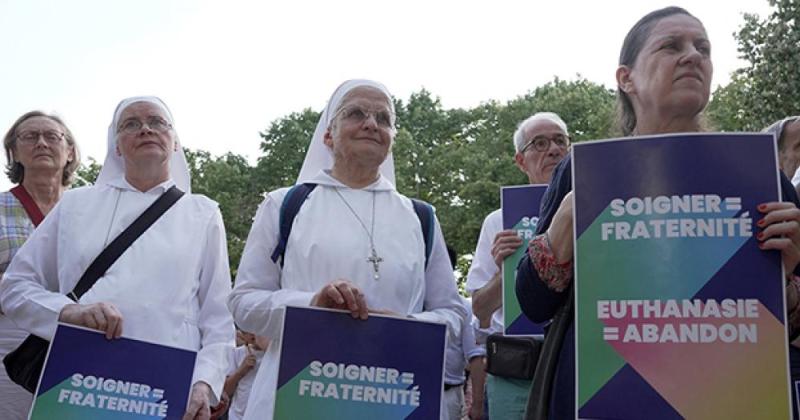
The issue of euthanasia has once again come to the fore of European public debate after the French National Assembly approved a law authorizing what is termed as "assistance in dying" on 15 July 2026. The legislation was passed by a majority of 53.3 per cent of the members present, with 291 deputies voting in favor and 241 against. Thus, France joins several European countries in this regard including Holland, Belgium, Spain, Luxembourg, and Portugal.
After a lengthy legislative process, the French law allows an adult patient suffering from a serious, incurable illness, and in an advanced or terminal stage, while experiencing intolerable pain that cannot be adequately relieved, to request ending one’s life by means of a lethal substance as the patient may administer the substance personally, or, if physically unable to do so, it may be administered by a physician or a nurse. Supporters of the law argue that it upholds individual freedom and the right to choose a dignified end to one's life. However, opponents warn of its ethical and legal implications, particularly with regards to the protection of society's most vulnerable members.
Holland, the first country in the world to legalize euthanasia in 2001, now presents striking information, as over the past quarter century the annual number of euthanasia cases has increased from fewer than 2,000 to more than 10,000, which represents approximately 6 per cent of all deaths. Furthermore, the scope of eligible cases has increased beyond terminal illnesses to include certain cases of dementia and psychiatric disorders. This development has led many physicians and ethicists to warn of what is commonly known as the "slippery slope", namely the gradual expansion of the law's application to situations that were never envisaged when it was originally enacted.
On the other hand, the Catholic Church stresses its unwavering position that human life is a sacred gift, from the moment of conception until death, and that no one has the right to deliberately end human life, regardless of the severity of suffering. The catechism of the Catholic Church stipulates that euthanasia contradicts human dignity and the sanctity of life, while clearly distinguishing between intentionally ending life and forgoing useless or disproportionate medical treatments when they no longer offer a real hope of recovery.
The bishops of France have recently stressed that the enactment of a legislation permitting euthanasia and assisted suicide marks a serious turning point in the nation's history. They argued that this fundamentally changes the society's perception of old age, illness, and disability, as well as undermines trust between patients and physicians, while threatening the most vulnerable, especially the elderly people who may come to feel that they have become a burden on their families.
The French bishops stressed that the real alternative lies in accompanying patients and alleviating their suffering rather than ending their lives. They expressed their gratitude to all those who care for the sick, the elderly, and the persons with disabilities, while affirming that the Church will continue to defend the dignity of every human life based on its belief that the greatness of a society is measured by its ability to care for its weakest members until the end, rather than making death easier for them.
The position of the French bishops reflects the Catholic Church's firm teachings in this regard which is not confined to rejecting euthanasia, but rather advocates a humane alternative based on the development of palliative care, alleviating pain, in addition to comprehensive medical, psychological, and spiritual support for patients and their families. In its view, human dignity is not diminished by illness, old age, or disability; it rather remains inherent in every person until the moment of natural death.
The debate relevant to euthanasia is not confined to legal considerations, yet it raises a profound civilizational question, namely is the humanity of a society measured by its ability to facilitate death, or by its ability to accompany those who suffer by offering them hope and compassionate care until the end? This is a question that will continue to resonate in the conscience of humanity, regardless of how laws may change.