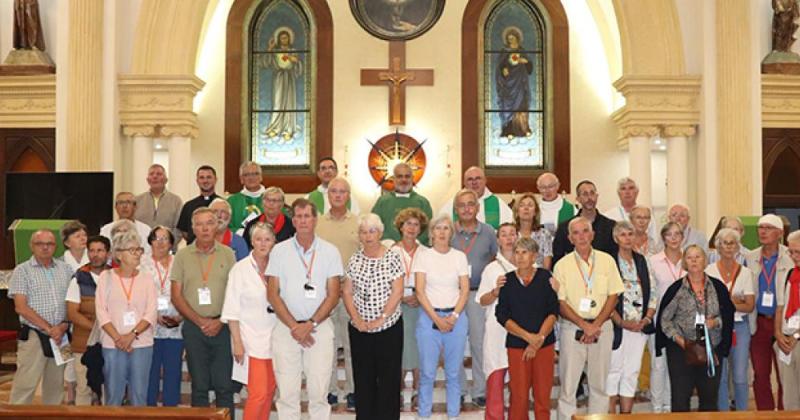
Every other week or so, groups of Christian pilgrims come to us, namely Jordan, to live the experience of spiritual pilgrimage, so we say in the first place, praise be to God that pilgrimage trips are beginning to return to our beloved Jordan, after a long hiatus caused by three major challenges over the past six years, namely COVID-19 pandemic, the war in Gaza, and the Iran war in the region.
We earlier marked high visitor and pilgrim numbers as one million people visited Petra, some 700,000 visited Mount Nebo and 350,000 visited the Baptism Site. Since then, we have been saying that we want to restore the 2019 figures.
Today, we plead with God to help Jordan transcend the current ordeal in the wake of the two terrorist attacks in Hamoud, where nine martyrs fell, and in Amman, where heroic Corporal Jawad Al-Salaytah was martyred.
When pilgrims come to us, they usually ask for two things, namely to pray in one of Jordan’s Churches, and to listen to an address about Christianity and the religious landscape in Jordan. They ask several questions most of which are: Will the recent events impact tourism? We say: God willing, no. Thank God, we have not heard of mass cancellations of pilgrimage trips scheduled to Jordan.
However, tourism in Jordan has not usually been affected by purely Jordanian circumstances, but rather by the regional situation has a great impact, especially the complications facing our brethren in Palestine. We hope that God would send true peacemakers to this land blessed with the birth, baptism, death, and resurrection of Lord Jesus Christ. The current relative stability encourages tourists and pilgrims to return to this Holy Land.
Furthermore, preparations are underway for the year 2030, namely the Jubilee year marking 2,000th anniversary of the baptism of Lord Jesus Christ in Jordan River. This necessitates that the current operating committees carry out their marketing role as soon as possible, because foreign pilgrims plan their trips years in advance. Thus, the year 2027 will be decisive with regards to preparation, marketing, and getting the infrastructure ready to receive thousands of pilgrims in the Jubilee year.
Furthermore, pilgrimage trips to Jordan were usually organized within the framework of joint programs with other countries, especially Palestine. Today, however there are major efforts, particularly with European tourism circles, to persuade pilgrims to come to Jordan as an independent pilgrimage destination and to stay for eight days, a program I believe is suitable.
We have several Christian sites that are worth visiting, in addition to historical and archaeological sites, including medical tourism, which helps pilgrims discover entire Jordan, rather than only the Christian places.
I conclude by calling for enhancing the training and rehabilitation of tour guides, studying the languages that the sector needs, and developing their language-wise skills. I also call for creating optimum conditions for holding discussion sessions, not only between pilgrims and a single person who gives presentations, but rather between Jordanian groups as well as French, Italian, or Spanish groups, so that the pilgrimage journeys may also serve as an occasion for cultural and intellectual exchange between young Jordanians and pilgrims from friendly countries, who always show great respect and appreciation for our dear Jordan, its leadership and its people.