As for the political aspect, it is already well known, and we do not wish to elaborated on it at length. There are fixed Palestinian principles affirming that any final solution must be based on the establishment of an independent Palestinian state on its national soil, with Jerusalem as its capital. This is the position that Jordanian diplomacy has always upheld in its unwavering support for the Palestinian rights. But, what I want to address today is not the political aspect, but rather how this reality is reflected on the people's socio-economic life.
A few days ago, I went past the Church of the Nativity in Bethlehem to attend a wedding of friends, and I noticed nearby several shops, what we locally call "souvenir shops", displaying antiques, rosaries, and statues skillfully carved from Palestinian olive wood. Most of these shops were closed, and some whose doors were ajar as their owners complained not just of a decline in visitor numbers, but of an almost complete absence of the tourists and pilgrims who used to flock every day by the dozens, hundreds, even thousands every day. Today, these vendors sit contemplating the tiles of the Nativity Square, now that the footsteps of pilgrims, whose different languages once filled the place with life and joy, have vanished.
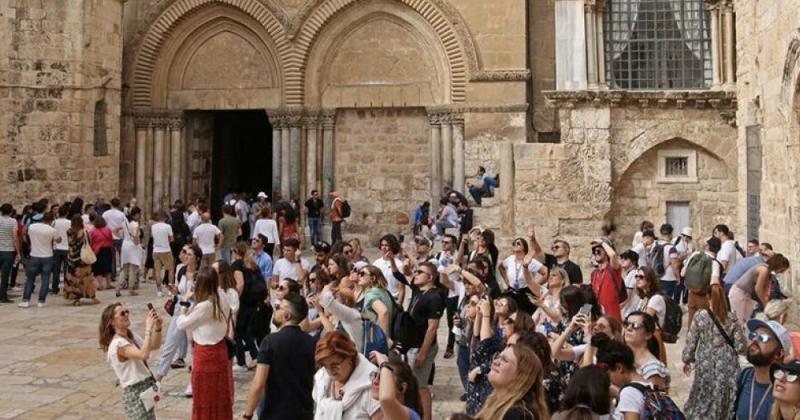
This scene was repeated the following day when I went to Jerusalem to pray at the Church of the Holy Sepulcher. The markets of the Old City--the ones Fairouz sings about in "The Old Streets of Jerusalem"-- are almost empty of any tourists or pilgrims, a sight that stirs deep sorrow. I met several vendors whom I have known since my school days in Beit Jala, when we used to come to Jerusalem every day or every other day. I still remember Jerusalem with its open gates, before the erection of checkpoints and the closures, when we would sometimes walk from Beit Jala to the Church of the Holy Sepulcher and the Latin Patriarchate in under an hour.
It is painful to see everything built over so many years regresses to this extent. The COVID-19 pandemic dealt a harsh blow to global tourism, then the war on Gaza erupted to prevent pilgrims from arriving in the Holy Land, and finally the Iranian-Israeli-American war and the accompanying regional tensions aggravated the wave of cancelled bookings and organized trips.
Where are we heading? No one can predict, and no real peace plan appears on the horizon yet, given the flagrant emergence of settlements. But it is certain that only peace can resuscitate religious tourism. This region needs a period of stability during which pilgrims' trust can be restored, so that they may return to the Holy Land to seek blessings at its sacred sites, and at the same time support the thousands of families who depend for their livelihood on these visits, through selling religious antiques crafted with skill, love, and a clear conscience.
In this respect, I offer my prayers for the late friend Ibrahim Lolas of Beit Jala, one of the most prominent carvers of olive wood, who devoted his life to making the religious keepsakes that pilgrims took with them to every corner of the world. He took pride in his mission and his craft, but he passed away a few weeks ago due to a shortage of medicine in the Palestinian territories, which is a painful violation of one of the simplest human rights, namely the right to receive medical treatment and obtain medicine.
We also regret the state of tourism, which seemed to me these past few days to be nearly lifeless in Bethlehem and Jerusalem, and pray to God that religious tourism may regain its splendor in the Holy Land. Tourism needs the return of pilgrims, not only to visit the holy shrines, but also to breathe life into the people who live nearby, who guard them with their faith and patience, and who maintain their Christian and human presence through the new generations.
In this context, I recall what Cardinal Pierbattista Pizzaballa, Latin Patriarch of Jerusalem, called for in his pastoral letter issued a few weeks ago, when he appealed to Christians around the world not to forget the Holy Land, and to return to it whenever circumstances allow, since pilgrimage is not merely a visit to holy sites but rather an act of solidarity and hope, and a direct support for the families who preserve this faith heritage and live by it. The Holy Land needs pilgrims, just as the pilgrims need the Holy Land. In this mutual encounter, the living memory of the Gospel is preserved, and the presence of the Christian community that has remained a witness to these holy places across the centuries continues.
Of course, what is said about the reality of tourism applies to Jordan as well. We are still in a recovery phase, as our tourism sector has been significantly affected by regional events. We address this issue, as we have done several times earlier, and we will discuss this topic of breathing life into the tourism situation in future articles, God willing.