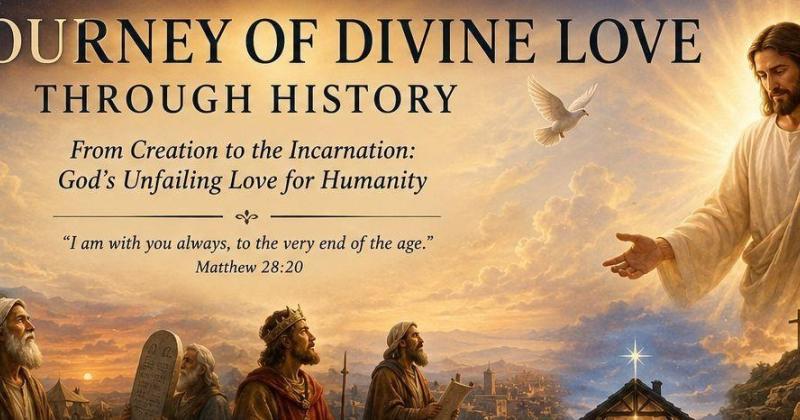
Ever since humanity began to contemplate its own existence, one profound question has echoed through the depths of the human heart across generations: Who is God? How has He revealed Himself to humanity? And can the human mind truly comprehend the greatness of the Creator who brought the universe into existence from nothing, established galaxies in their courses, numbered the stars of heaven, and called each of them by name? How could this infinite, eternal, and everlasting God enter into a relationship with finite and fragile humanity, making the entire history of mankind a story of encounter between the Creator and His creation?
This reflection is a spiritual journey into the heart of God’s providential plan throughout sacred history. It invites us to read history through the eyes of faith and to trace the footprints of divine love from the very moment of creation until the fullness of God’s self-revelation in the Incarnation. It is a journey that reveals how God has never ceased speaking to humanity, continually taking the initiative to seek, call, and draw people to Himself—generation after generation and century after century—until the story of humanity became, at its very core, the story of a God who loves mankind beyond all imagination.
When we read the Holy Scriptures as one unified narrative, we discover that their many books are not disconnected stories but successive chapters of one continuous divine dialogue that began at the dawn of creation and continues to this day. Throughout this journey, we witness God’s gradual self-revelation, with every stage of history adding a new dimension to humanity’s understanding of Him until this unfolding revelation reaches its summit in the mystery of the Incarnation.
The Beginning: God Draws Near to Humanity
The opening pages of Genesis present a remarkable scene: God creates humanity in His own image and likeness and immediately enters into a personal relationship with them. Humanity was not merely another creature among millions but the unique object of God’s love and special care.
Genesis portrays God blessing Adam and Eve and speaking directly to them. (Genesis 1:28; 2:16–17) From the very beginning, we discover that God is not an unknown force or an abstract philosophical concept but a living God who desires to be known, loved, and encountered.
Yet humanity fell and chose to distance itself from its Creator. Even so, God’s first words after the Fall were not words of condemnation but of compassionate invitation:
“Where are you?” (Genesis 3:9)
God was not asking because He did not know Adam’s whereabouts; rather, He was calling humanity back to Himself. From that very moment, the history of salvation began—the journey of divine love that continues to this very day.
The First Promise of Salvation
Even within the tragedy of the Fall, the first light of hope appeared.
God declared to the serpent: “I will put enmity between you and the woman, and between your offspring and hers; He shall crush your head, and you shall strike His heel.” (Genesis 3:15)
The Church has long understood this verse as the first announcement of the coming Redeemer. Before the tears of the Fall had even dried, God proclaimed that evil would not have the final victory and that a plan of salvation had already been prepared from eternity.
Here God’s sovereignty and majesty shine forth. He is never surprised by history, nor shaken by humanity’s failure. Instead, He transforms even tragedy into the beginning of redemption.
The God Who Never Ceased Speaking
Generations passed, yet God never fell silent.
He spoke to Cain (Genesis 4:6), addressed Noah amid a corrupt world, (Genesis 6:13) and established His covenant with him after the flood. (Genesis 9:8–17)
Then He called Abraham: “Go from your country and your kindred…” (Genesis 12:1).
Through Abraham, a new chapter in sacred history began. God promised him: “In your offspring all the nations of the earth shall be blessed.” (Genesis 22:18)
From that moment onward, salvation extended beyond the individual to embrace all humanity. God’s promise was never intended for one nation alone but for every people and every generation yet to come.
Promises Clarified Through the Centuries
As history unfolded, the portrait of the promised Savior became progressively clearer.
Jacob foretold that the coming King would arise from the tribe of Judah:
“The scepter shall not depart from Judah.” (Genesis 49:10)
Through Moses, God declared: “The Lord your God will raise up for you a prophet like me.” (Deuteronomy 18:15)
To David He promised an everlasting kingdom: “I will establish the throne of his kingdom forever.” (2 Samuel 7:13)
It is as though God were painting an immense masterpiece spanning thousands of years, adding new colors and new lines in every generation until the picture would be completed according to His eternal wisdom.
The Prophets Saw from Afar
Then came the prophets, bringing even clearer glimpses of the future.
Isaiah proclaimed: “Behold, the virgin shall conceive and bear a son.” (Isaiah 7:14)
He also declared: “His name shall be called Wonderful Counselor, Mighty God, Everlasting Father, Prince of Peace.” (Isaiah 9:6)
In Isaiah 53, he portrayed the suffering servant who bears the sins of many and intercedes for transgressors.
Micah revealed the place of birth: “But you, Bethlehem…” (Micah 5:2)
Daniel envisioned: “One like a Son of Man coming with the clouds of heaven.” (Daniel 7:13)
Every prophet added another stone to the foundation of hope, and every generation longed more deeply for the fulfillment of God’s promise.
The Waiting of the Centuries
Empires rose and fell. Kingdoms disappeared. Civilizations changed.
Yet God’s word remained alive.
The faithful awaited the promised Messiah. They read the prophecies, meditated on God’s promises, and longed for the day when God would visit His people.
The long periods of silence often tested their faith, but God was quietly at work, guiding history toward the appointed moment He had prepared from eternity.
Thus, we learn that God’s apparent delay is never His absence but part of His perfect wisdom. Time, in God’s hands, is not measured as humanity measures it.
The Fullness of Time
Then came the moment generations had awaited.
The Apostle Paul writes: “But when the fullness of time had come, God sent forth His Son.” (Galatians 4:4)
And the Gospel proclaims: “The Word became flesh and dwelt among us.” (John 1:14)
Here the journey of divine love reached its highest point.
The One who spoke with Adam, called Abraham, walked with Moses, and inspired the prophets did not merely send messengers, words, or prophecies. He drew as near to humanity as could ever be imagined.
The Incarnation is God’s greatest revelation of love, for it shows that He desired not merely to speak to humanity but to share human life itself—to enter our history, our suffering, our joys, and our weakness.
What Does This Journey Teach Us?
It teaches us that God remains faithful to His promises regardless of how long fulfillment may seem to take.
It teaches us that God remains Lord of history, even when events appear confusing or beyond understanding.
It teaches us that God is infinitely patient, never weary of calling humanity back to Himself.
Above all, however, it teaches us that God is love.
From the Fall until the fullness of time, God never abandoned humanity.
From His first question in Eden, “Where are you?” (Genesis 3:9),
to His final promise, “I am with you always, to the very end of the age.” (Matthew 28:20), one thread binds together every page of Scripture, every chapter of history, and every act of salvation: the unchanging love of God.
Conclusion
When this journey comes to its end, we realize that it is not merely the story of Adam, Abraham, Moses, or the prophets—it is our story as well.
The God who searched for Adam still searches for humanity today. The God who spoke through the patriarchs and prophets still calls hearts to know Him. The God who guided all history toward the fulfillment of His promise continues to guide every human life toward Himself.
The greatest discovery one can make through this journey is not simply a deeper knowledge of sacred history but the realization of a profound and timeless truth: God loved humanity first. The entire history of salvation is nothing less than the story of that divine love—a love that existed before creation, unfolded throughout history, and continues to invite every person into eternal communion with Him.
In the age of artificial intelligence, when machines are capable of learning, knowledge is available at the touch of a button, and humanity stands closer than ever to uncovering the mysteries of matter and the universe, we simultaneously discover that the deepest mysteries of existence still reside within the human soul. The more capable humanity becomes of creating powerful tools, the greater its need for the wisdom to guide their use. The more our understanding of the world expands, the greater becomes our need to know ourselves and our Creator.
For this reason, the journey of divine love throughout history remains the deepest framework for understanding existence itself, for it is the only journey that leads not merely to greater knowledge but to the very meaning of existence—and ultimately to an encounter with the God who was in the beginning, who is today, and who remains forever.